The Culcasi Family has been the salt family for more than 100 years
For four generations, the age-old traditions of the ancient salt workers from Trapani have remained alive here. In the name of work, hard endeavours and respect for the culture of an activity able to shape the identity of an entire territory. Inextricably linked to the territory of the salt pans of Trapani, Saline Culcasi produces and markets the sea salt of Trapani respecting the traditional habits and rituals, cultivating and collecting this precious gift of the sea within the Salt-pans Reserve of Trapani which is a WWF area and a FAI. (Italian Foundation for the Environment) “luogo di cuore” (place of heart)
The Culcasi Family has been the salt family for more than 100 years
For four generations, the age-old traditions of the ancient salt workers from Trapani have remained alive here. In the name of work, hard endeavours and respect for the culture of an activity able to shape the identity of an entire territory. Inextricably linked to the territory of the salt pans of Trapani, Saline Culcasi produces and markets the sea salt of Trapani respecting the traditional habits and rituals, cultivating and collecting this precious gift of the sea within the Salt-pans Reserve of Trapani which is a WWF area and a FAI. (Italian Foundation for the Environment) “luogo di cuore” (place of heart)
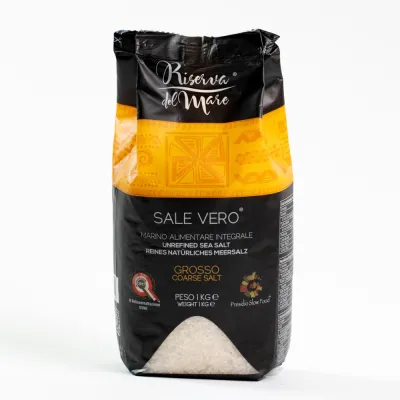
We work the salt in keeping with nature and tradition. Rigorously, without forcing or excesses. This is how true Sicilian excellences are born, both food and well-being. Discover all of our products in the online catalogue
Visita guidata alle Saline di Trapani ed al Museo del Sale
Immergiti in un luogo senza tempo, fra panorami mozzafiato, testimonianze storiche e degustazioni al tramonto. Scopri tutte le lavorazioni del sale seguendo insieme a noi il Percorso del Salinaio. Grazie ai nostri meravigliosi tour guidati potrai scoprire l'antica storia delle Saline di Trapani e del nostro meraviglioso Museo del Sale, vivendo insieme a chi ami un'esperienza sensoriale unica nel suo genere grazie alle nostre guide.
Visita guidata alle Saline di Trapani ed al Museo del Sale
Immergiti in un luogo senza tempo, fra panorami mozzafiato, testimonianze storiche e degustazioni al tramonto. Scopri tutte le lavorazioni del sale seguendo insieme a noi il Percorso del Salinaio. Grazie ai nostri meravigliosi tour guidati potrai scoprire l'antica storia delle Saline di Trapani e del nostro meraviglioso Museo del Sale, vivendo insieme a chi ami un'esperienza sensoriale unica nel suo genere grazie alle nostre guide.
At the table, salt is essential: here are some dishes in which it becomes the protagonist,
themed events and all the curiosities about this ingredient.
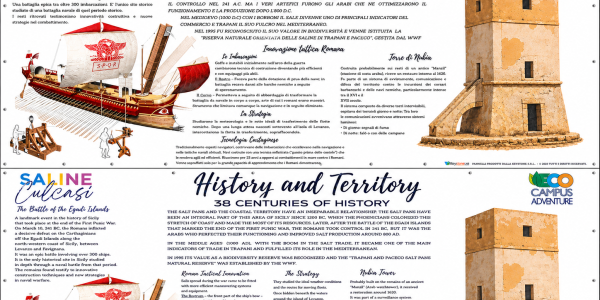
The salt pans and the coastal territory have an inseparable relationship. The salt pans have in fact been an integral presence in this part of Sicily since 1200 B.C., with the Phoenicians who colonized this stretch of coast and began its exploitation.
Later, after the Battle of the Egadi Islands, which marked the end of the First Punic War, the Romans took control of them in 241 B.C. However, the true architects were the Arabs, who optimized their functioning and production after 800 A.D.
In the Middle Ages (1000 A.D.), with the Bourbons, salt became one of the main indicators of trade and Trapani its hub in the Mediterranean.
In 1995, its value in terms of biodiversity was recognized and the “Riserva Naturale Orientata delle Saline di Trapani e Paceco”, managed by WWF, was established.
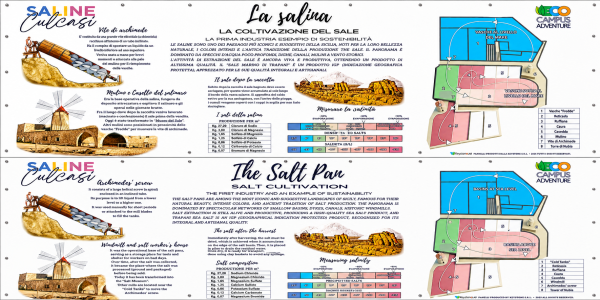
The first example of a sustainable industry
The salt pans are one of the most iconic and evocative landscapes of Sicily, known for their natural beauty, intense colors, and the ancient tradition of salt production.
The panorama is dominated by shallow water basins, embankments, canals, and historic windmills.
Salt extraction is still active and productive today, producing a product of the highest quality. “Trapani Sea Salt” is a PGI product, Protected Geographical Indication, appreciated for its integral and artisanal qualities.
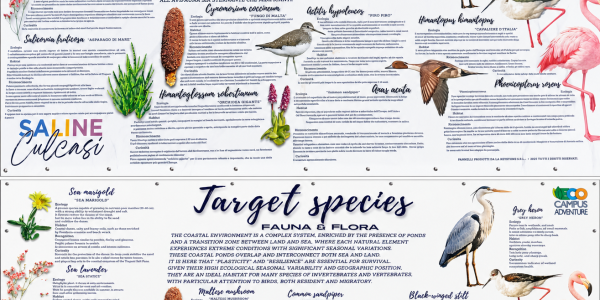
The coastal environment is a complex system, enriched by the presence of the basins, and is a transition zone between land and sea where every natural element experiences extreme conditions with large daily and seasonal variations.
Food webs overlap and are interconnected between sea and land.
Here, “plasticity” and “resilience” are essential for survival. Due to its great seasonal ecological variability and its geographical position, it is an ideal ecotone for many species, from bacteria to higher vertebrates, with particular attention to both wintering and nesting birdlife.
Salt pans are places where human work, the force of nature and traditional tools come together. This article presents the contents of the panel dedicated to the tools, processes and phases of salt harvesting.

 Italiano
 English