Italiano
 English
Shopping Cart
There are no more items in your cart
Overview: morphology & ecology
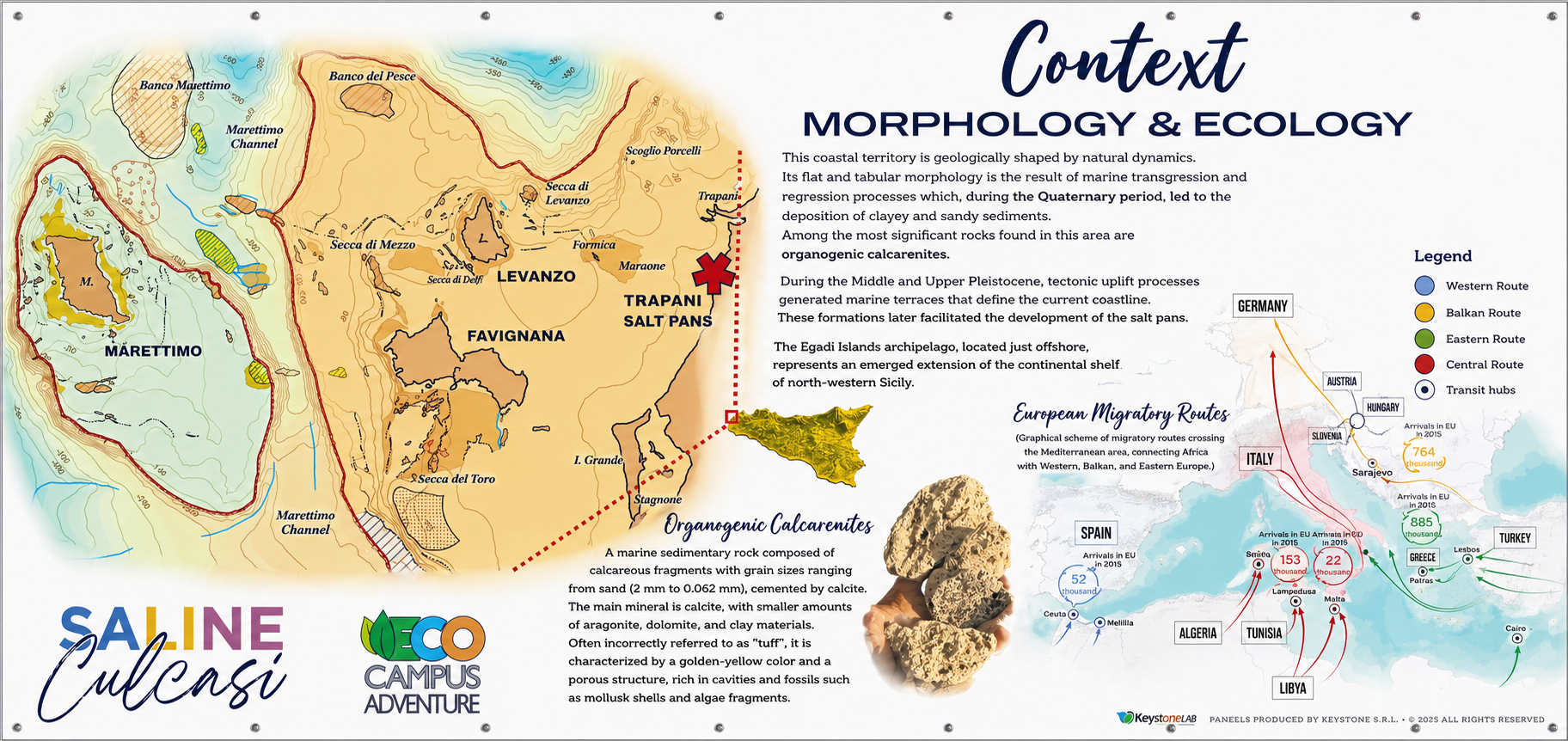
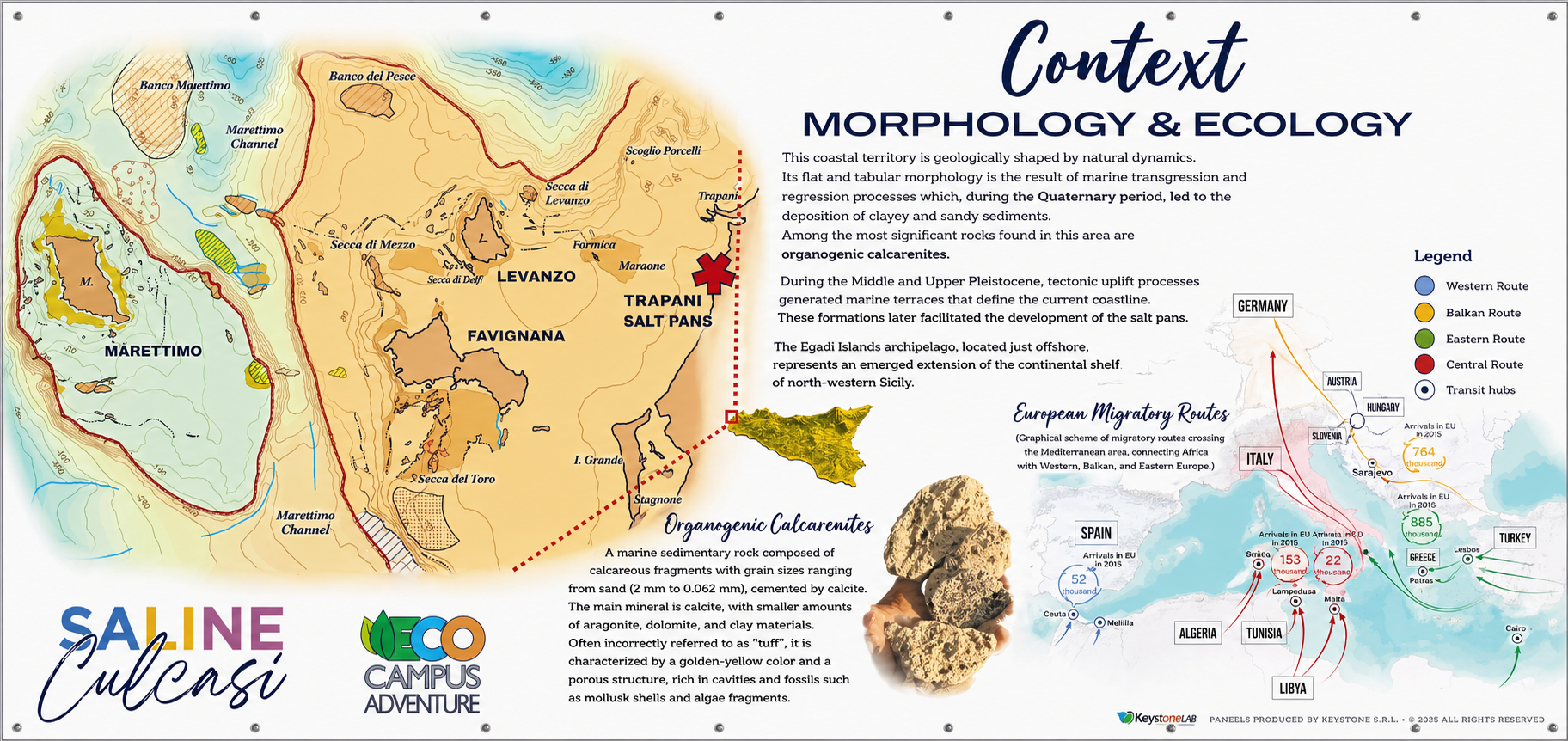
This coastal territory is geologically influenced by natural dynamics. Its flat and tabular shape is determined by marine transgression and regression processes which, during the Quaternary period, deposited clayey and sandy sediments; among the most important rocks are organogenic calcarenites.
During the Middle and Upper Pleistocene, tectonic uplift actions generated marine tectonic terraces that characterize the current shape of the coast and later favored the development of the salt pans.
The archipelago of the Egadi Islands, facing the salt pans, represents an emerged extension of the continental platform of the north-western sector of Sicily.
Organogenic calcarenites
It is a sedimentary rock of marine origin made up of calcareous fragments the size of sand, ranging from 2 to 0.062 mm, cemented by calcite.
The main minerals are calcite and, to a lesser extent, aragonite, dolomite and clayey materials. Incorrectly called “Tuff”, it has a characteristic golden-yellow color and a porous structure with cavities, rich in fossils of organisms such as mollusk shells and fragments of algae.
European migration routes
- Western Route
- Balkan Route
- Eastern Route
- Central Route
- Transition and accumulation nodes
The Trapani Salt Pans in their natural context
The Trapani Salt Pans are part of a coastal territory shaped over time by geological processes, marine dynamics and natural phenomena that have contributed to the formation of a unique landscape.
To experience this environment up close, along with its features and the connection between nature, history and salt-making culture, you can join the guided tours of Saline Culcasi.
Discover the guided tours of Saline Culcasi