
 Italiano
 English
Shopping Cart
There are no more items in your cart
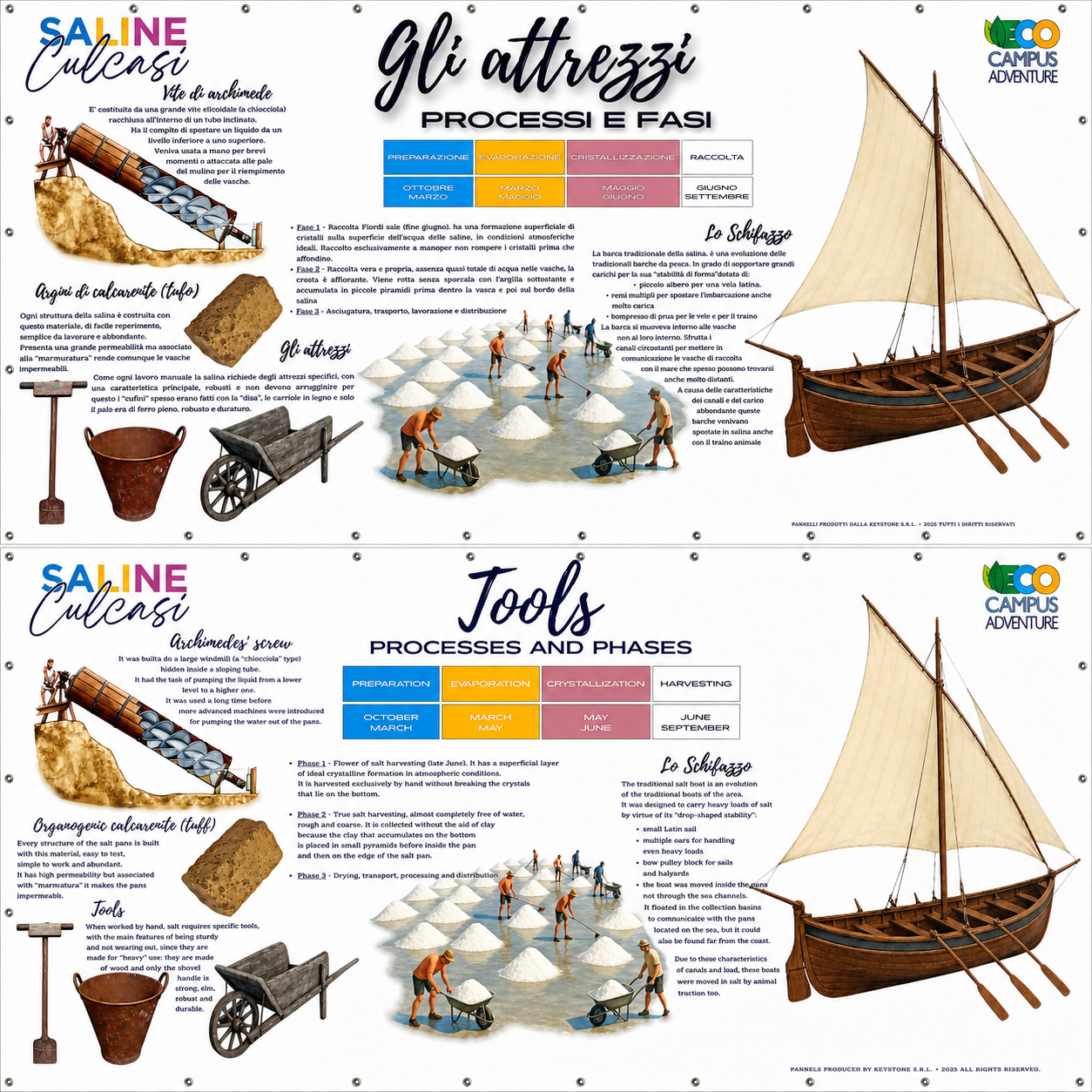
Tools: processes and phases
Work in the salt pans is the result of human effort, natural elements and traditional tools. This article faithfully presents the contents of the panel dedicated to the tools, processes and phases of salt harvesting.
Archimedes’ screw
It consists of a large helical screw, shaped like a spiral, enclosed inside an inclined tube.
Its purpose is to move a liquid from a lower level to a higher one.
It was used by hand for short periods or attached to the blades of the mill to fill the basins.
Calcarenite embankments, known as tuff
Every structure of the salt pan is built with this material, which is easy to find, simple to work and abundant.
It has great permeability, but when combined with “marmuratura”, it still makes the basins waterproof.
Processes and phases
| Preparation | Evaporation | Crystallization | Harvesting |
|---|---|---|---|
| October - March | March - May | May - June | June - September |
- Phase 1 - Harvesting of Fior di Sale, late June. It forms as a thin layer of crystals on the surface of the water in the salt pans, under ideal atmospheric conditions. It is harvested exclusively by hand so as not to break the crystals before they sink.
- Phase 2 - The actual harvesting phase, with an almost total absence of water in the basins and the salt crust emerging. It is broken without dirtying it with the clay underneath and accumulated in small pyramids, first inside the basin and then on the edge of the salt pan.
- Phase 3 - Drying, transport, processing and distribution.
The tools
Like every manual job, work in the salt pan requires specific tools with one main characteristic: they must be sturdy and must not rust. For this reason, the “cufini” were often made with “disa”, the wheelbarrows were made of wood, and only the pole was made of solid iron, sturdy and durable.
The Schifazzo
The traditional boat of the salt pan is an evolution of traditional fishing boats. Able to carry heavy loads thanks to its “form stability”, it was equipped with:
- a small mast for a lateen sail;
- multiple oars to move the boat even when heavily loaded;
- a bowsprit at the bow for the sails and for towing.
The boat moved around the basins, not inside them. It used the surrounding canals to connect the harvesting basins with the sea, which could often be very far away.
Because of the characteristics of the canals and the heavy load, these boats were also moved within the salt pan by animal traction.
Discover the salt pan in person
To learn more about the tools, the harvesting phases and salt-making culture, you can join the guided tours of Saline Culcasi.