
 Italiano
 English
Shopping Cart
There are no more items in your cart
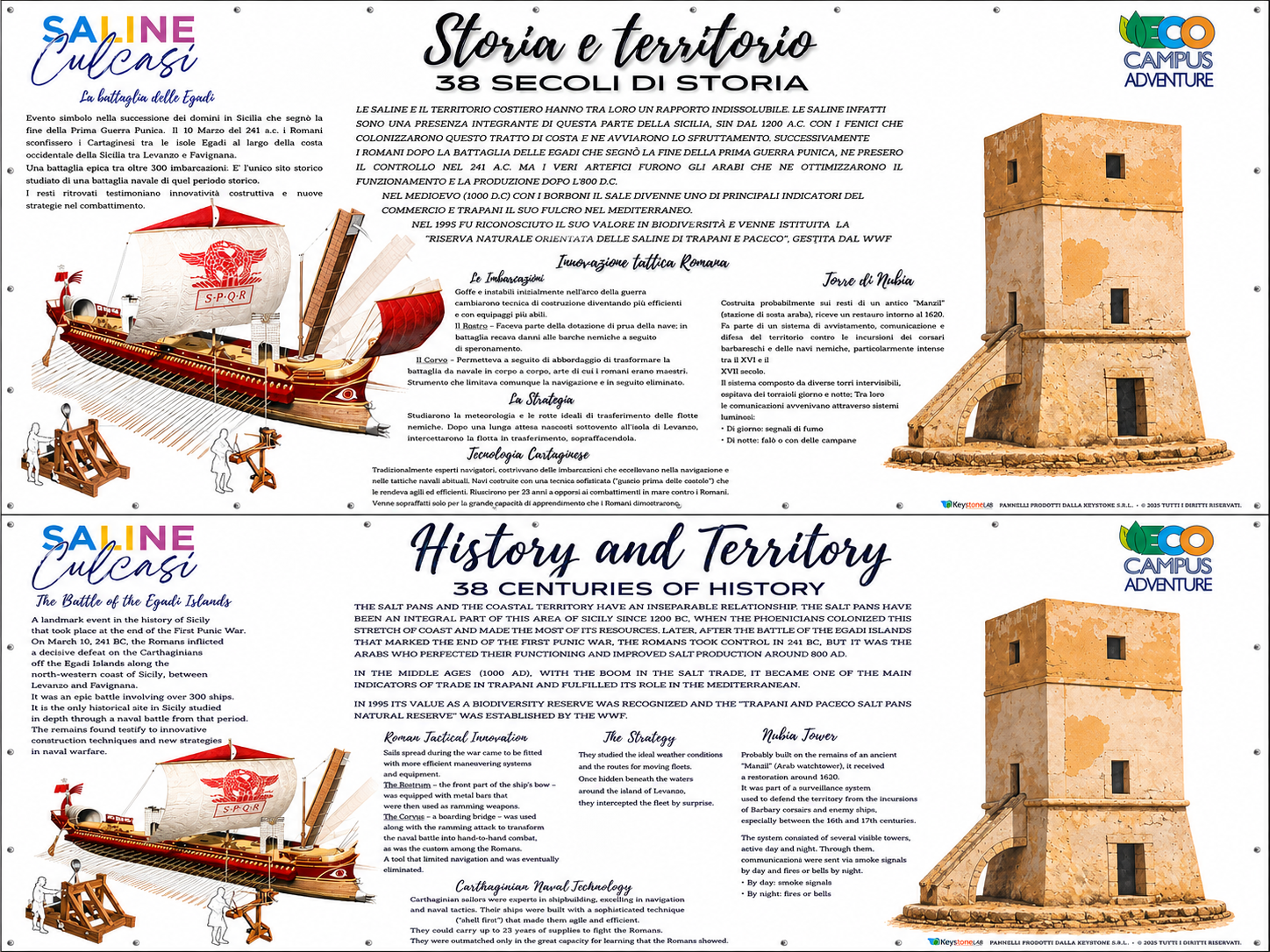
The salt pans and the coastal territory have an inseparable relationship. The salt pans have in fact been an integral presence in this part of Sicily since 1200 B.C., with the Phoenicians who colonized this stretch of coast and began its exploitation.
Later, after the Battle of the Egadi Islands, which marked the end of the First Punic War, the Romans took control of them in 241 B.C. However, the true architects were the Arabs, who optimized their functioning and production after 800 A.D.
In the Middle Ages (1000 A.D.), with the Bourbons, salt became one of the main indicators of trade and Trapani its hub in the Mediterranean.
In 1995, its value in terms of biodiversity was recognized and the “Riserva Naturale Orientata delle Saline di Trapani e Paceco”, managed by WWF, was established.
The Battle of the Egadi Islands
A symbolic event in the succession of dominions in Sicily, it marked the end of the First Punic War. On March 10, 241 B.C., the Romans defeated the Carthaginians among the Egadi Islands, off the western coast of Sicily between Levanzo and Favignana.
An epic battle involving over 300 vessels. It is the only historical site studied of a naval battle from that historical period.
The remains found bear witness to constructive innovation and new strategies in combat.
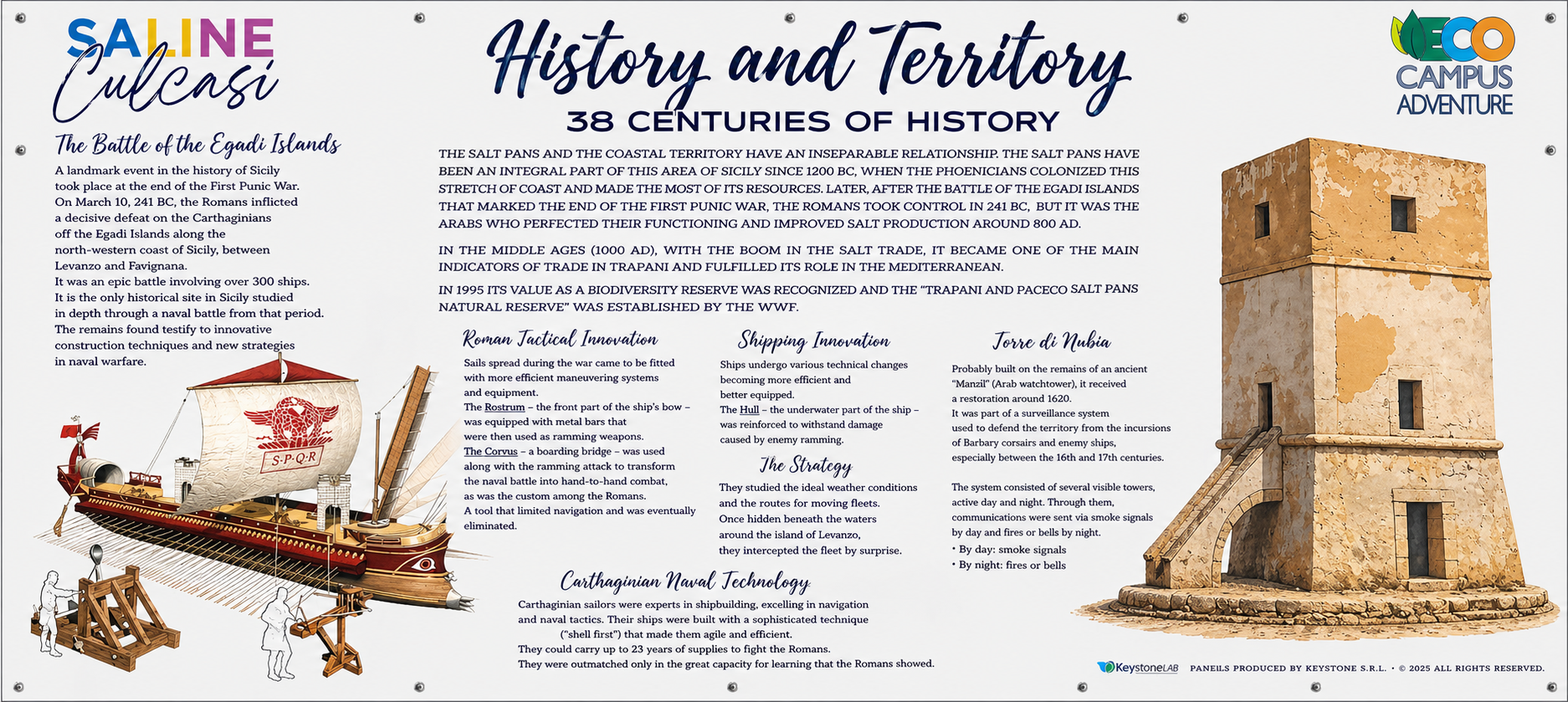
Roman tactical innovation
The vessels
Clumsy and unstable at first, over the course of the war they changed construction technique, becoming more efficient and with more skilled crews.
The rostrum - It was part of the equipment at the bow of the ship; in battle it caused damage to enemy boats through ramming.
The corvus - After boarding, it made it possible to transform the battle from naval combat into hand-to-hand combat, an art in which the Romans were masters. It was a tool that nevertheless limited navigation and was later eliminated.
The strategy
They studied meteorology and the ideal routes for the transfer of enemy fleets. After a long wait hidden downwind of the island of Levanzo, they intercepted the fleet in transit, overpowering it.
Carthaginian technology
Traditionally expert navigators, they built vessels that excelled in navigation and in customary naval tactics. Ships built with a sophisticated technique (“shell first, ribs later”) that made them agile and efficient.
For 23 years they managed to oppose the Romans in sea battles. They were overcome only by the great learning ability shown by the Romans.
Torre di Nubia
Probably built on the remains of an ancient “Manzil” (Arab stopping station), it was restored around 1620.
It is part of a system of observation, communication and defense of the territory against the incursions of Barbary corsairs and enemy ships, particularly intense between the 16th and 17th centuries.
The system, composed of several intervisible towers, hosted watchmen day and night; communication between them took place through light-based systems:
- By day: smoke signals
- By night: bonfires or bells