
 Italiano
 English
Shopping Cart
There are no more items in your cart
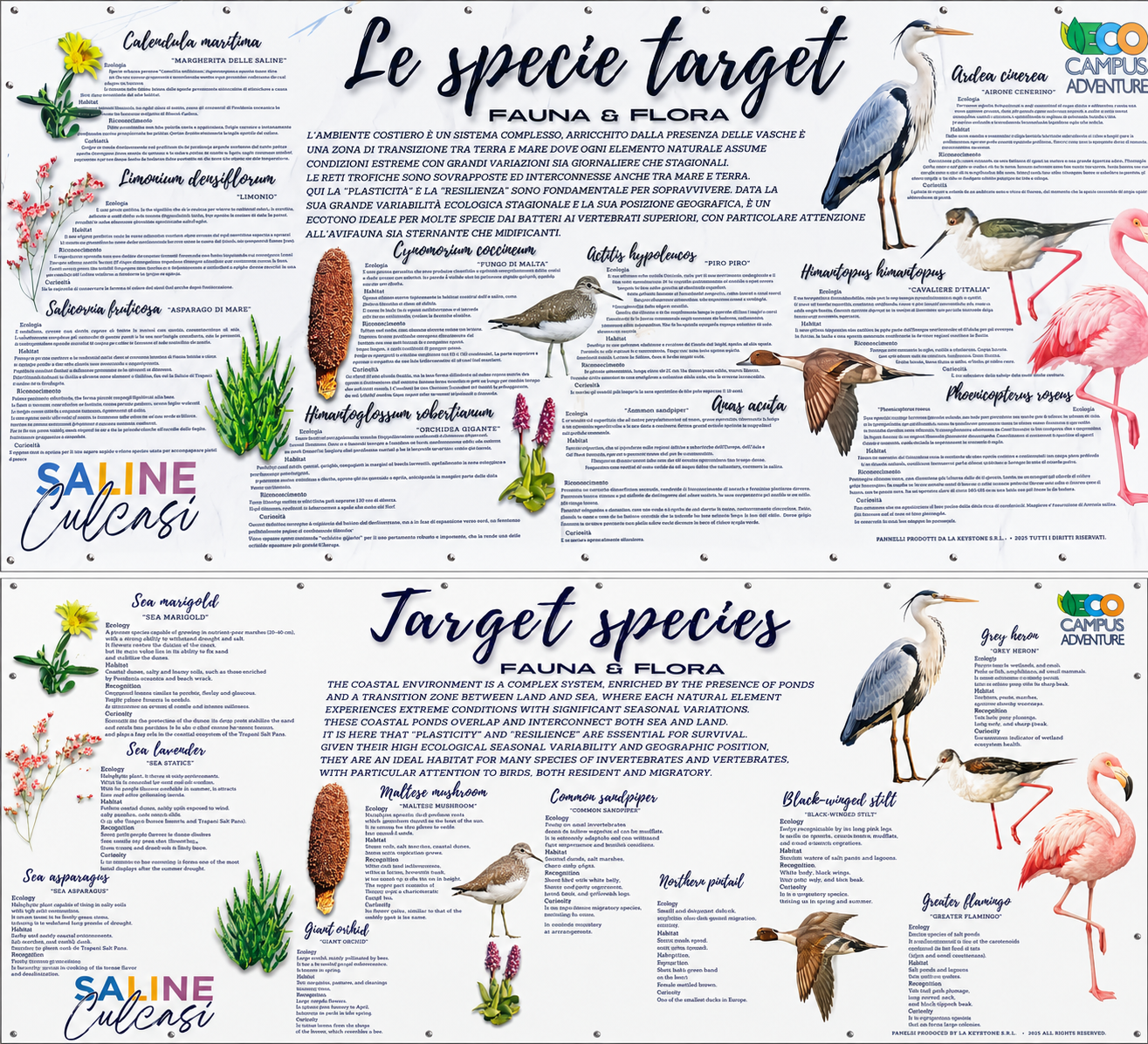
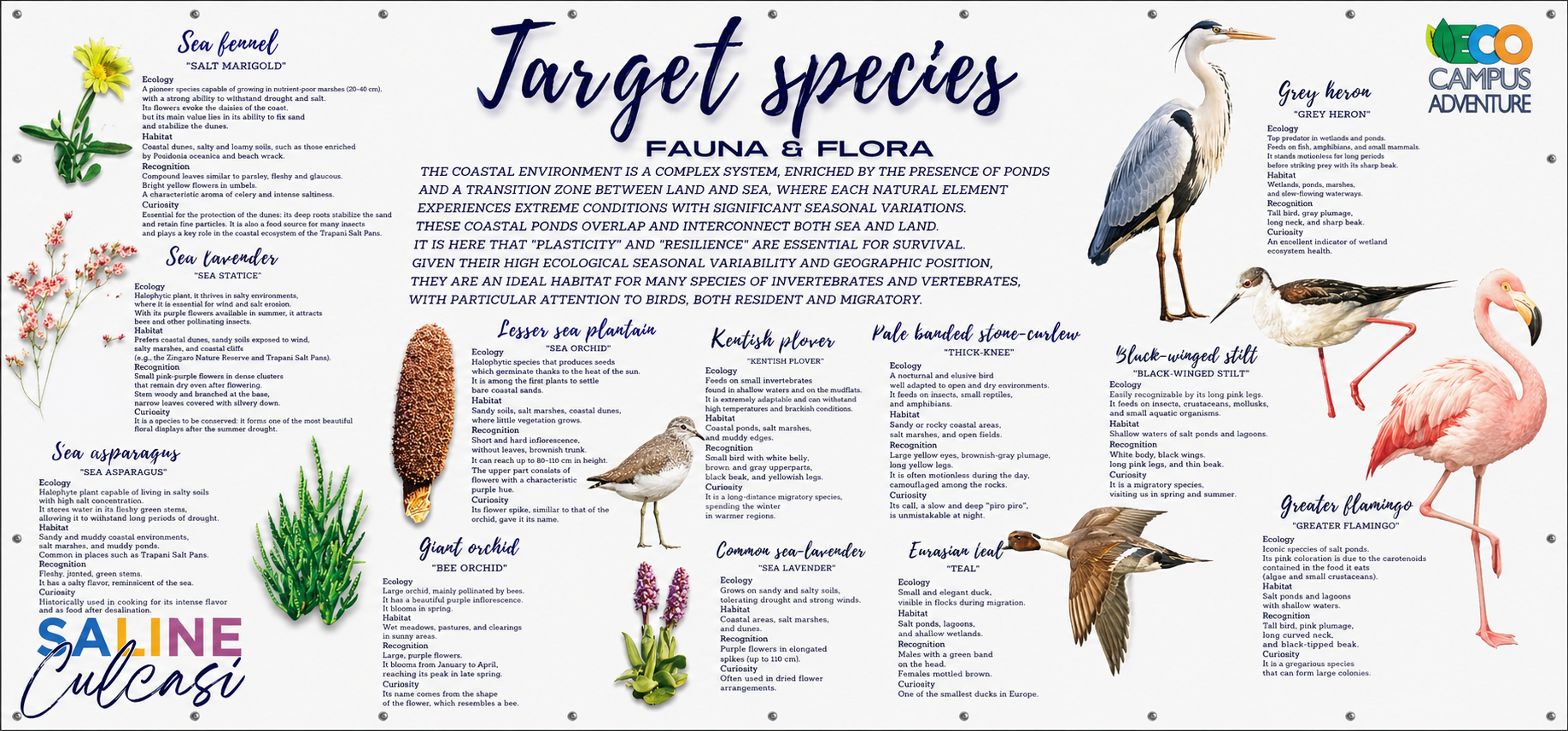
The coastal environment is a complex system, enriched by the presence of the basins, and is a transition zone between land and sea where every natural element experiences extreme conditions with large daily and seasonal variations.
Food webs overlap and are interconnected between sea and land.
Here, “plasticity” and “resilience” are essential for survival. Due to its great seasonal ecological variability and its geographical position, it is an ideal ecotone for many species, from bacteria to higher vertebrates, with particular attention to both wintering and nesting birdlife.
Calendula maritima - “Sea marigold”
Ecology
A perennial herbaceous species, “chamaephyte suffruticose”, it reaches a height of about 20-40 cm, with an initially upright habit that later becomes prostrate and trailing, resting on the ground.
It is included in the Red List of species seriously threatened with extinction due to the fragmentation of its habitat.
Habitat
It prefers coastal environments, on nitrogen-rich soils, such as accumulations of Posidonia oceanica and the sandy dunes of the coastline between Marsala and Monte Cofano.
Recognition
Stems covered with dense, short and sticky hair. Fleshy and intensely fragrant leaves, also covered with hair. The basal leaves are different from those of the corolla.
Curiosity
It plays a fundamental role in purifying the air by recycling the nitrogen present in organic remains brought by the sea. It is able to tolerate the water and soil stress typical of coastal environments; it survives only in some stretches of the coastline of the province of Trapani, between Marsala and Monte Cofano.
Limonium densiflorum - “Sea lavender”
Ecology
It is a halophyte plant, meaning that it has evolved to live in saline environments. It is xerophytic, adapted to arid soils or soils with limited water availability. To manage excess salt, the plant expels sodium through specialized glands on its leaves.
Habitat
Its preferred habitat is coastal brackish areas, where it grows on maritime cliffs exposed to salt spray. Native populations have been documented in areas such as Nubia, in the municipality of Paceco (TP).
Recognition
It is a perennial plant with a root that grows in tufts, forming a woody base from which the branches emerge. It has short basal rosettes of oblanceolate-spatulate leaves, widened at the tip and narrowing towards the base, with 3-5 clearly visible veins.
Its most distinctive feature is the inflorescence, composed of dense spikes gathered in a violet-colored panicle, with flowering between June and August.
Curiosity
It has the ability to preserve the shape and color of its flowers even after drying.
Salicornia fruticosa - “Sea asparagus”
Ecology
It is a halophyte, a plant capable of living in soils with a high salt concentration. The most remarkable ecological adaptation of this species is its succulent morphology, which allows it to store large amounts of water to dilute the excess salt absorbed from the soil.
Habitat
It thrives in coastal areas and saline environments, where the soil is soaked with salt water and where most other plants would not be able to survive.
It prefers sandy or sandy-coarse, well-drained and brackish soils.
Distribution in Italy: it is widespread in various Italian brackish areas, including the Trapani Salt Pans, Veneto and Sardinia.
Recognition
A perennial shrubby plant that forms small woody bushes at the base. The stem is fleshy, succulent and jointed, like small sausages, with no visible leaves.
The leaves are reduced to fleshy scales, pressed against the stem. Its color changes with the season. In spring and early summer it is bright green, while in late summer and autumn it takes on reddish tones.
Flowers: the flowers, barely visible, are arranged in groups of three in small niches at the leaf axils, and appear between August and November.
Curiosity
It is appreciated in cooking for its savory taste and is often used to accompany fish dishes.
Cynomorium coccineum - “Fungus of Malta”
Ecology
It is a holoparasitic plant that does not produce chlorophyll and depends completely on the roots of other plants for nourishment. The plant is visible only in spring, April-June, when it emerges to flower.
Habitat
This plant typically grows in arid and saline coastal habitats, such as salt marshes and sand dunes.
It is found throughout the Mediterranean region and extends into western Asia, including the Arabian Peninsula.
Recognition
It is not a fungus, but an herbaceous plant without a woody trunk. It has a phallic shape that emerges directly from the ground, has no branches and is an intense reddish-brown color, sometimes tending towards dark purple.
It can reach a height of between 10 and 30 centimeters. The upper part is thick and covered with a dense inflorescence of small scarlet flowers.
Curiosity
It is a flowering plant, but its cylindrical shape and dark red color, emerging directly from the ground, caused it to be mistaken for a fungus for a long time.
Already in the 18th century, the Knights of Saint John, Knights of Malta, protected it, making Fungus Rock in Gozo one of the first protected sites in Europe.
Himantoglossum robertianum - “Giant orchid”
Ecology
It reproduces mainly through entomophilous pollination, carried out by bumblebees, Bombus. Since it does not produce nectar, the orchid attracts pollinators by hosting colonies of aphids, Dysaphis tulipae, which produce honeydew that accumulates in the flower and attracts insects.
Habitat
It prefers dry meadows, pastures, garrigue, shrublands and the edges of thermophilous woods, especially in sunny or partially shaded areas.
It is one of the first orchids to flower, often as early as January and April, anticipating most other wild species.
Recognition
Robust, upright and cylindrical stem, which can exceed 50 cm in height.
Labellate flowers enclosed in a spike inflorescence with as many as 65 flowers.
Curiosity
This terrestrial orchid is native to the Mediterranean basin, but is expanding northwards, a phenomenon probably linked to climate change.
It is often nicknamed “giant orchid” because of its robust and imposing habit, which makes it one of the largest wild orchids in Europe.
Actitis hypoleucos - “Common sandpiper”
Ecology
It is a fascinating wader, known for its bobbing movement and its distinctive flight. It is an extremely adaptable bird and can be found in a wide range of aquatic environments.
It feeds mainly on aquatic and terrestrial invertebrates such as insects, mollusks, crustaceans and annelids, which it catches by probing the mud or picking food from the surface.
It nests in Europe and Asia, especially along the banks of rivers, lakes and waterways. It makes its nest in a simple depression on the ground, usually hidden by vegetation. It is not a gregarious bird and is often seen alone or in small groups.
Habitat
It prefers gravelly, sandy or rocky shores of rivers and lakes, even at high altitude.
During migration and wintering, it frequents a greater variety of wetland environments, including the Salt Pans, where it is easy to observe.
Recognition
Small in size, about 19-21 cm long. It has an olive-brown back and a white belly.
It is famous for its bobbing and rhythmic tail movement, which makes it recognizable.
Curiosity
It is one of the longest-lived birds, and its life expectancy can exceed 10 years.
Anas acuta - “Northern pintail”
Ecology
It is a dabbling duck that feeds mainly in shallow waters, using its long neck to collect food. Its diet is omnivorous. It forms large flocks during migrations in the winter period.
Habitat
A migratory species that breeds in the Arctic and subarctic regions of Europe, Asia and North America, before moving south for wintering.
It breeds in freshwater wetlands, with vegetation that is not too dense. It frequents a variety of wetlands, both freshwater and brackish, and winters in the salt pan.
Recognition
It shows marked sexual dimorphism, making the recognition of males and females quite different.
The male is elegant and slender, with a long pointed tail from which its name derives, and a chocolate-brown head. The chest, throat and belly are bright white, extending in a stripe along the side of the neck. The back is finely streaked grey and it has a bronze-green wing patch and a grey-green bill.
Curiosity
It is generally a silent duck.
Ardea cinerea - “Grey heron”
Ecology
A fundamental apex predator in freshwater and brackish ecosystems, it has great adaptability, which has allowed it to thrive even in urbanized environments.
As a predator, it helps control populations of fish, amphibians and other small vertebrates and invertebrates, maintaining the balance of the food web.
Habitat
It shows great versatility in its choice of habitat, adapting to a wide range of aquatic environments, provided the waters are shallow. It inhabits freshwater or brackish wetlands where it also feeds on marine species.
Recognition
It is the largest heron in Europe, almost one meter tall and with a large wingspan. It has ash-grey plumage on the back and wings, with a white neck and clearly visible black stripes on the chest.
The head is white with a conspicuous black stripe running from the eye to the nape, where it forms an elongated tuft. The bill is robust, pointed and yellow. In flight, it is recognized by the neck folded in an “S” shape between the shoulders.
Curiosity
Its presence is an indicator of a healthy environment rich in resources, since the species requires clean water and an abundance of prey.
Himantopus himantopus - “Black-winged stilt”
Ecology
It is an unmistakable wader, known for its incredibly long and thin legs. It feeds on aquatic insects, crustaceans, mollusks, worms and other small invertebrates, which it catches in mud or shallow water.
A gregarious species, pairs form during the winter period after a striking courtship display.
Habitat
It is a migratory species that nests in much of southern Europe and Asia before wintering in Africa. In Italy it is a resident and nesting species in several regions, including Sicily.
Recognition
Extremely long, thin, pink legs. White body, with black wings and back in the male, brownish in the female. White head. Long, thin and straight black bill.
Curiosity
It is an indicator of the health of coastal wetlands.
Phoenicopterus roseus - “Greater flamingo”
Ecology
They are social birds and form large colonies, not only for protection but also to facilitate the search for food and reproduction. A migratory species, but under particular conditions such as the Salt Pans it can become a frequent guest and even nest.
Climate warming is contributing to the increase in observations. The curved bill is a highly specialized filtering organ. It helps maintain the balance of these fragile ecosystems by controlling populations of crustaceans and algae.
Habitat
The preferred habitat of the greater flamingo consists of coastal or inland wetlands with shallow waters and high salinity, a necessary condition for the presence of its preferred prey: Artemia salina.
Recognition
White-pink plumage, with more intense shades on the wings. Juveniles have duller plumage, greyish-white in color.
It has a very long, thin neck and legs and webbed feet. The bill is large and curved downwards, with a black tip. It has a wingspan of about 140-165 cm and a height that can exceed one meter.
Curiosity
They are not born pink, but acquire their color from a carotenoid-rich diet. The greater the intake of Artemia salina, the more intense the pink of their plumage will be.
If observed standing on one leg, it is sleeping.